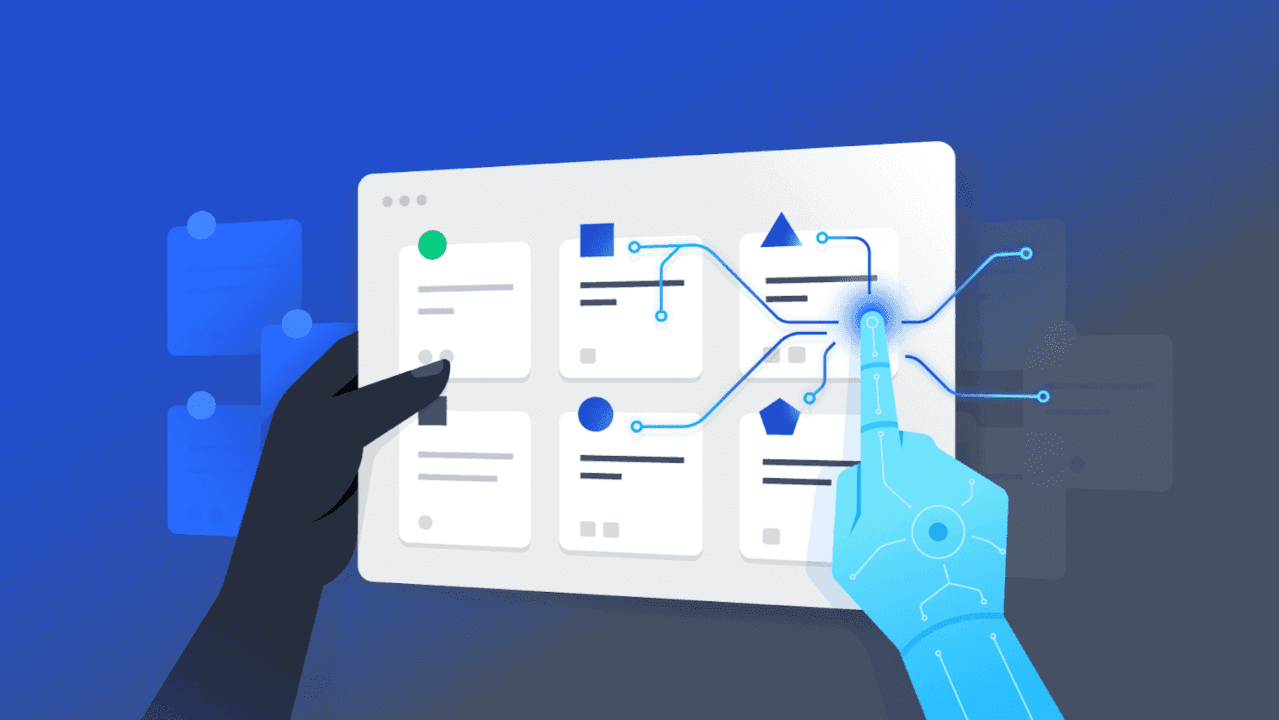
In the traditional world of project management, success was once defined by the "Iron Triangle": the delicate balance of scope, time, and cost. For decades, project managers (PMs) acted as the primary conduits for this balance, spending upward of 60% of their time on administrative overhead - updating Gantt charts, chasing status reports, and manually reconciling resource spreadsheets.
As we move through 2026, that world has officially vanished. The "administrative PM" has been replaced by the "Strategic Orchestrator." AI has transitioned from a novelty tool to the very nervous system of project delivery. Drawing from the frameworks established by ScienceDirect, the Association for Project Management (APM), and industry leaders like CIO and Planview, this article examines the current reality of AI-native project management.
The Reality of 2026: From Augmented to Agentic
While 2024 and 2025 were about "augmentation" - using AI to help humans do tasks, 2026 is the year of Agentic AI. According to recent research from ScienceDirect and Gartner, over 40% of enterprise applications now feature embedded, purpose-built AI agents.
In today's landscape, AI doesn't just suggest a schedule; it manages it. We have moved into a "Self-Healing" project environment:
Predictive Success Modelling
Project leaders now use "Digital Twins" of their projects. Before a single resource is assigned, PMs run thousands of simulations to stress-test the project against historical failure patterns.
Autonomous Workflow Orchestration
2026 marks the dominance of Multi-Agent Systems. A PM now directs a "fleet" of agents, a Triage Agent for ticket management, a Resource Agent for capacity balancing, and a Governance Agent for compliance monitoring.
Real-Time Sentiment Analysis
By processing anonymised communication signals across platforms like Slack and Teams, AI now provides a "Team Health Score," alerting PMs to burnout or friction weeks before it impacts the critical path.
Technical breakdown: The "self-healing" schedule
The defining technical achievement of 2026 is the Autonomous Scheduling Loop. This architecture removes the need for manual Gantt updates.
How the Autonomous Loop Functions
Signal Capture: The AI monitors "Low-Level Signals" (code commits, document edits, meeting outcomes).
Drift Detection: If a task takes 15% longer than the predictive baseline, the AI calculates the "downstream ripple" across the entire portfolio.
Conflict Resolution: Instead of flagging the error for the PM, the AI Agent identifies a team member with a lighter load and the required skill signature.
Auto-Negotiation: The agent sends a "Proposal for Re-assignment" to both team members. If they accept, the schedule updates itself instantly.
The Edge-Inference shift
To address the data privacy concerns, the enterprise landscape of 2026 has shifted toward Edge Inference. Critical project data no longer leaves the corporate firewall. Large Language Models (LLMs) are now "shaded," with smaller, specialised versions running locally on project devices to ensure zero-latency response times for global teams.
Strategic Intelligence: The PM as "AI Director"
The reports from APM and CIO were correct: AI didn't replace the Project Manager; it removed the places they used to hide. With status reports and resource balancing automated, the value of a PM in 2026 sits in Human-Centric Leadership and Decision Intelligence.
From Reporting to Interpreting
The PM’s job is no longer to provide a dashboard, but to challenge it. If the AI predicts a project will fail, the PM must use their "contextual edge" - understanding the unquantifiable office politics or the sudden shift in a stakeholder's personal life, to decide whether to trust the machine.
The EthOps Mandate
Every modern PMO now has an EthOps (Ethics Operations) function. This involves auditing AI-driven resource allocation to ensure "Algorithmic Fairness" which guarantees that "productivity-tracking" agents aren't inadvertently penalizing remote workers or those in different time zones.
2026 Strategic Checklist: Upskilling for the agentic era
As we navigate this "Silicon-based workforce" (as Deloitte calls it), project leaders must master a new set of "Power Skills." If you aren't yet proficient in these areas, you are effectively managing in the past.
The PM "Power Skill" checklist
[ ] Agentic Orchestration: Can you design a workflow where multiple AI agents interact with human team members without creating "bottleneck loops"?
[ ] Prompt Engineering for PMO: Have you mastered the art of "System Prompting" to build custom bots that mirror your organization's specific methodology (e.g., a "Wagile" bot)?
[ ] Data Provenance Auditing: Do you know the origin of the data your AI is using to make cost forecasts? Can you spot "Data Poisoning" or biased historical trends?
[ ] Sentiment Intelligence: Are you able to bridge the gap when an AI flags "Team Friction" but the human team claims everything is fine?
[ ] ROI Proofing: In 2026, the "hype" is over. Can you provide a measurable ROI for your AI investments (e.g., reduced cycle times or 30% lower resource wastage)?
Conclusion
In 2026, we have finally stopped talking about "how" to do project management and started talking about "what" we are achieving. The transition from manual oversight to Accountable Intelligence has allowed PMs to focus on what actually matters: strategy, empathy, and innovation.
The successful project manager of today is no longer a "tracker." They are an orchestrator of a hybrid workforce - a leader who knows when to let the AI run the engine and when to take the wheel themselves.