The global economy is becoming increasingly digital, but many of the financial processes underpinning it still rely on fragmented systems, manual intervention, and documents designed primarily for human rather than machine processing. Electronic invoicing, or eInvoicing, represents an important step toward changing this. By turning invoices into structured, machine-readable data that can move automatically between businesses, service providers, and tax authorities, eInvoicing is becoming part of the infrastructure of a more connected digital economy.
The electronic invoicing system is designed not simply to replace paper or digital format invoices, but to establish a standardized digital framework through which invoice information are created, validated, exchanged, and reported electronically. The government defines an eInvoice as structured invoice data issued and exchanged electronically between a supplier and buyer and reported electronically to the Tax Authorities. It specifically distinguishes this from digital format documents, scanned copies, images, and emails, which are not considered technically as an eInvoice.
eInvoicing is not merely the digitization of an existing document. It represents the transformation of invoicing into a data-driven business process. As governments and organizations adopt this model, invoicing can increasingly become connected to process like accounting, procurement, tax, payments, analytics, and to any of broader enterprise systems.
Need Of A Structured Data
Businesses may have been sending invoices electronically for many years. However, emailing a digital document is fundamentally different from exchanging an eInvoice.
A document may be digital, but the information it contains is generally designed to be read by a person. Unless additional extraction technology is used, a receiving accounting system cannot automatically understand the information within that document.
An eInvoice instead uses a defined structured data format, allowing information such as the vendors, customers, transactional reference number, taxable amount, products or service information, with transaction values to be interpreted automatically by compatible systems. An example of eInvoice framework could be designed as below:
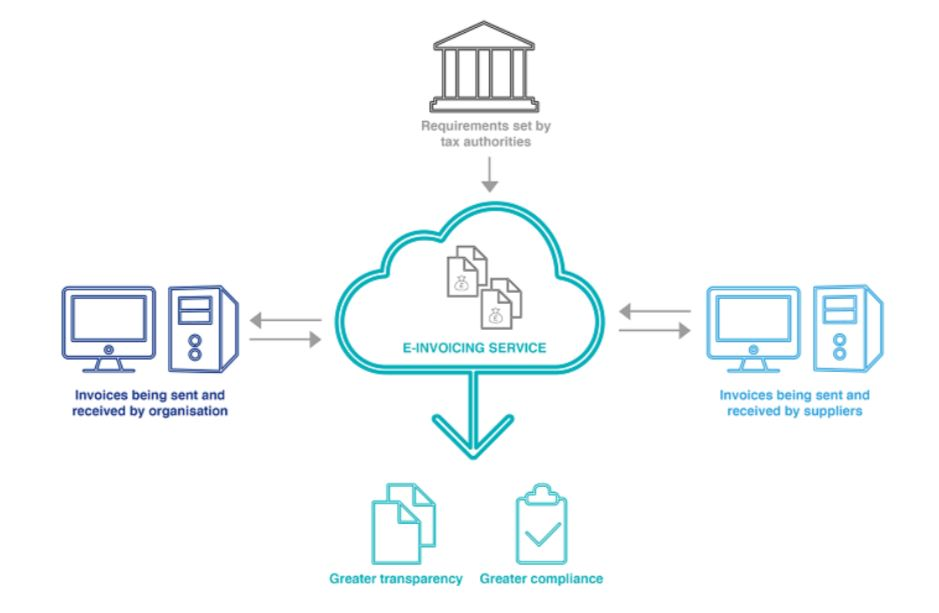
As an example the UAE's framework reflects this distinction. It is built around structured XML and the PINT AE standard, the UAE implementation of the Peppol International Invoice standard. Under the framework, invoice pass through Accredited Service Providers, that facilitate validation, conversion, transmission, and reporting.
This provides an important foundation for digitization because standardized information can move between organizations without continually being reformatted or manually restructured.
The impact therefore extends beyond the accounts. Structured invoice data can become part of an organization's broader information architecture, connecting enterprise resource planning systems, procurement platforms, accounts payable and receivable functions, tax reporting, and financial analytics.
Creating An Automated Economy
One of the clearest contributions eInvoicing makes to the digital economy is automation.
Traditional invoicing frequently involves a sequence of manual activities: producing an invoice, emailing it, receiving it, transitioning information into another system, validating the data, resolving discrepancies, approving the invoice, and eventually processing payments. Every manual step intervention introduces time, cost, and the possibility of error.
eInvoicing changes this model by allowing systems to communicate directly. In this digital systems, the vendor submits invoice related data to its Accredited Service Provider. The provider validates the information and, where required, converts it into the governance based standard XML framework. The invoice gets transmitted to the customers service provider while relevant taxable information is reported to the Tax Authorities. The information like status are subsequently exchanged so that intervening resources can identify a information has been successfully processed, completing the stage process.
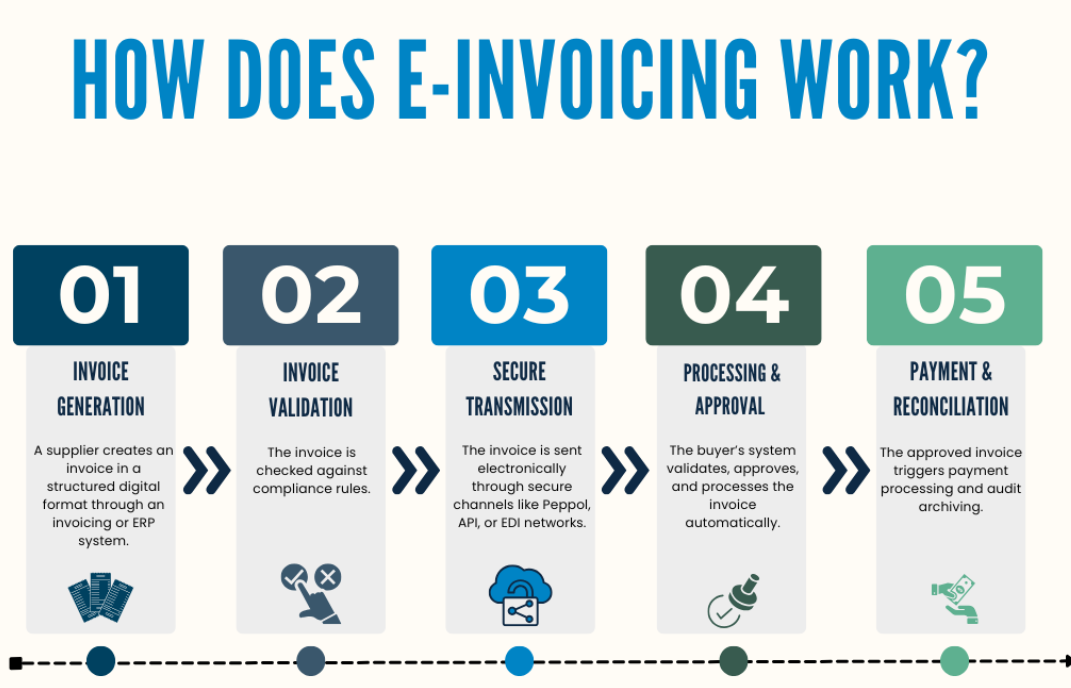
Processes that previously depended on digital documents and manual created information, can therefore become increasingly automated.
At sufficient scale of the digitization, this matters considerably. Invoicing is one of the most common commercial interactions within an economy. It improves the efficiency of each transaction creating cumulative benefits across organizations and potentially millions of transactions.
As part of the governance, it is understood based on international experience eInvoicing can reduce transactional processing costs by up to approximately 66 percent. While savings will naturally vary by organization to organization and implementation, the principle is significant: standardization creates opportunities to remove repetitive transactional dependency with manual intervention and redirect resources toward higher-value activity.
Accuracy and Data Quality
A digitized economy depends not only on having more data, but on having reliable data. Manual invoice processing creates several opportunities for mistakes. The data can be created incorrectly, mandatory information may be omitted, invoice references may be duplicated, and tax information may be incorrectly categorized.
Structured eInvoicing creates the opportunity to apply automation rules and validation before information progresses through the transaction systems.
Accredited Service Providers play an important role in validating process of e-invoice information and ensuring that it conforms to prescribed standards. ClearTax notes that incoming invoices can arrive in structured, machine-readable form, reducing the need for manual data entry in accounting payable processes, while outgoing transactions can be checked against required formats before transmission.
Greater accuracy has consequences beyond compliance. Reliable invoice information improves the quality of financial reporting and reduces the operational effort required to investigate discrepancies.
This becomes increasingly valuable as organizations adopt artificial intelligence, advanced analytics, and automated financial systems. These technologies are only as dependable as the information they receive. Structured eInvoicing can therefore help create a cleaner financial data layer upon which additional digital capabilities can be developed.
Strengthening Cash Flow and Working Capital
Digitization is also influencing how quickly organizations can complete commercial transactions.
Errors and incomplete information frequently delay approval and payment as part of the business process. An invoice may be sent to the wrong stakeholder, entered incorrectly, or held while discrepancies are investigated. Small and Medium businesses, these delays may impact on working capital.
The organization identifies improved cash flow as one of the business benefits of eInvoicing. Standardized invoice creation, automated exchange, and built-in controls can reduce errors while allowing invoices to reach buyers in near real time, creating opportunities for shorter transaction cycles and faster payment.
Solutions similarly identifies faster payments as a potential advantage, arguing that automated validation can reduce delays caused by incorrect invoices and improve working capital availability.
Faster transactional processing can make cash flow more predictable, helping organizations manage payment systems, vendors, investment, and other operating requirements.
Consequently, eInvoicing should not be viewed exclusively as a tax related technology. Properly implemented, it will greatly contribute to broader transactional and financial efficiency.
Making Sophisticated Technology Accessible
Another important dimension of digital transformation is inclusivity. Large enterprises traditionally possess greater resources to invest in sophisticated systems, automation platforms, and dedicated technology teams. Smaller or Medium organizations may have fewer opportunities to make comparable investments.
It is also understood that a large percent of businesses are microbusinesses with annual turnover below AED 3 million in regional market like GCC. One objective of its approach is therefore to create a more technological environment by making digital capabilities available across the overall business community.
A common eInvoicing infrastructure can support this objective because organizations interact through defined standards rather than entirely proprietary processes.
Small and medium enterprise organizations become participants in the same digital transaction ecosystem as larger enterprises. This encourages the adoption of compatible accounting systems, cloud based services, automated standardized workflows, and digital financial management.
The result is potentially a broader form of digital transformation. Instead of sophisticated automation being concentrated among major organizations, common standards can encourage digital participation throughout the supply chain process.
Enabling Greater Financial Visibility
eInvoicing also converts a historically document-based process into an increasingly valuable source of structured business intelligence.
When invoice information is stored consistently, organizations can analyze it more easily. Organizational teams may gain greater visibility into payment cycles, customer behavior, transactional liabilities, vendor and customer activities, standard pricing, discrepancies, and transactional volumes.
This specifically highlights the potential for richer financial information and proactive decision-making because transactional information becomes available in machine-readable form.
This has implications for both businesses and governments. For both entities, structured invoice data can support cash-flow forecasting, procurement analysis, vendor management, and financial planning. Management teams can identify patterns more quickly because information does not first need to be extracted from thousands of individual documents.
For governments, near-real-time tax information can provide a more detailed view of economic activity. The Ministry of Finance states that this information can provide policymakers with deeper insight into areas and sectors that may require support or intervention. eInvoicing therefore demonstrates how digitization can develop into economic intelligence.
Supporting Smarter Tax Process
Tax related process is another major sector being transformed. Traditional tax reporting frequently relies on businesses periodically summarizing historical transactions before finalizing and submitting returns. eInvoicing can bring relevant transaction data closer to tax systems throughout the normal course of business. The Decentralized Continuous Transaction Control and Exchange model requires relevant tax information to be transmitted through Accredited Service Providers to the Federal Tax Authority.
Greater automation may reduce accidental reporting errors. Standardized transaction information may make inconsistencies easier to identify. Digital audit trails may simplify verification. The governance establishes the framework to contribute toward reducing VAT leakage and to facilitate automatic processing of VAT return information and faster refund processing.
It becomes important the relationship between commercial systems and tax administration flow seamlessly. Compliance becomes less dependent on reconstructing historical information and increasingly embedded within day-to-day transactional infrastructure. For organizations, however, this also increases the importance of data governance. Transactional errors that once remained within internal systems may become more visible as financial information is exchanged and reported electronically. Data ownership, configuration, master-data quality, and internal controls therefore become central elements of transactional readiness.
Increasing Transparency and Security
Digital transactions also create opportunities to strengthen transparency. Electronic invoice networks can create detailed audit trails showing when a transaction was generated, transmitted, received, and processed. This improves traceability and makes discrepancies easier to navigate.
This program highlights this capability as an important benefit, noting that digital audit trails can help organizations identify issues including invoice delays, underbilling, and pricing inconsistencies.
Paper invoices and loosely controlled digital documents can be lost, duplicated, intercepted, or altered. Structured electronic exchange can incorporate stronger controls over authentication, access, integrity, and transmission.
The system identifies encrypted transactions and secure data-exchange protocols as elements that can reduce fraud and unauthorized access.
No digital system eliminates cybersecurity risk, and connecting financial systems creates responsibilities around access management, resilience, and data protection. Nevertheless, standardized secure networks can provide substantially greater control than fragmented document-based processes.
Connecting Businesses Across Borders
Digital economies do not operate only within national boundaries. Companies increasingly work with international vendors, customers, and platforms. If every jurisdiction and business uses incompatible invoice formats, organizations must continually translate information between systems.
Interoperability is therefore one of the most strategically important aspects of eInvoicing. The adoption of global standard networks like international OpenPeppol framework, becomes increasingly important. This can provide businesses with access to a wider network through which electronic invoices are exchanged with organizations outside the country. It is also understood Peppol as supporting international interoperability, cross-border trade, administrative efficiency, data integrity, and more accurate invoice exchange.
The principle is similar to other forms of digital infrastructure: common standards increase the number of organizations capable of interacting efficiently. For multinational organizations, this may eventually reduce the need to maintain entirely separate invoicing processes across different markets, although individual countries may continue to have their own legal and tax requirements.
The broader GCC market is also moving toward greater e-invoicing adoption. Example like Banqup notes developments across Saudi Arabia, Oman, and other GCC markets, indicates that electronic invoicing is becoming an increasingly significant component of regional digital transformation.
Supporting Paperless Economy
The environmental impact of individual invoices may appear relatively small, but invoicing occurs at enormous scale.
Traditional processes require creation, transportation, handling, storing, and eventually disposing of documents. Even partially digital processes may produce unnecessary paperwork at different points in the workflow.
eInvoicing supports a paperless model in which information can be created, transmitted, processed, and archived electronically. Modern solutions identifies this as a sustainability benefit that can contribute toward reducing the environmental footprint associated with business administration. The greater sustainability benefit, however, may come from process simplification. Digital transformation can reduce duplication, storage requirements, and administrative activity across entire ecosystems. In this sense, sustainability and operational efficiency can reinforce one another.
Preparing for the Next Stage
The implementation program demonstrates that eInvoicing should be treated as a business transformation initiative rather than simply a deadline-driven compliance project.
Meeting these requirements involves more than choosing a technology provider. Organizations need to understand where transactional data originates, assess the quality of that data, map information to required fields, integrate accounting systems, review existing processes, and establish responsibilities for resolving exceptions.
This describes the transition as structured data compliance rather than document digitization and argues that organizations should approach Accredited Service Provider selection as a strategic technology decision because these providers occupy a central position in validation, transmission, and regulatory reporting.
Organizations that approach implementation solely as a compliance exercise may achieve the minimum regulatory requirement while overlooking the broader opportunity.
The organizations that use it to improve financial architecture, data governance, and automation may realize substantially greater long-term value.
The Broader Impact on Digitized Economy
eInvoicing may appear to be a specialized function, but its wider economic implications are considerable.
It replaces documents with structured data. It connects previously fragmented systems. It reduces repeated manual work. It increases the speed at which financial information moves between organizations. It strengthens transparency and gives both organizations and governments richer information from which to make decisions.
Most importantly, eInvoicing creates infrastructure upon which further digitization can be built. Once invoices are structured and interoperable, businesses can readily automate reconciliation, payment process approval, cash-flow forecasting, procurement, and tax reporting. At the same time Artificial intelligence and analytics can operate on cleaner datasets. Vendors and Customers can interact through standardized networks. Governments can move toward more data-driven process.
As an example, UAE's program illustrates the broader ambition. The objective is not simply to modernize the format of an organizational transactions, but to use electronic invoicing to support a more digitally enabled fiscal and business ecosystem. The Ministry of Finance explicitly identifies digitization, reduced human intervention, economic competitiveness, improved policy insight, and the development of a digital economy among the key program's objectives.
As digital economies mature, the greatest transformations will not always come from highly visible consumer technologies. Some will occur within the underlying infrastructure through which organizations exchange information and conduct business. eInvoicing is one such transformation. By making one of the economy's most fundamental commercial processes as structured, automated, and interoperable, it creates a foundation for faster transactions, stronger compliance, better information, and increasingly connected digital commerce.